Best Queue Management Systems in India (2026 Comparison)
An honest comparison of queue management systems for Indian clinics, banks, and service centers — ValloraQ, Qmatic, Wavetec, Qminder — by cost, hardware, and fit.

Queue management used to be enterprise territory: hardware kiosks, proprietary displays, and quotes that only banks and airports could sign. That's changed — software-first systems now deliver tokens, displays, and voice announcements on hardware a small clinic already owns. But the market still mixes both generations, which makes comparisons confusing.
Here's an honest 2026 comparison for Indian businesses, from single clinics to branch networks — including our own product, ValloraQ, clearly flagged so you can account for our bias.
What actually matters in a queue system
Strip the brochures and a queue management system has five jobs:
- Issue tokens — fast, at reception or self-serve, for walk-ins and appointments together.
- Show the queue — a waiting-area display everyone can read at a glance.
- Call customers — announcements (ideally natural voice, not a beep) plus on-screen alerts.
- Route across counters — multiple counters, departments, or doctors without collisions.
- Report — wait times and service times per counter, hour, and day.
Judge every option on those five, plus the two questions that decide real cost in India: what hardware does it force you to buy, and what does support look like in your time zone and language?
The comparison at a glance
| System | Best for | Model | Watch out for |
|---|---|---|---|
| ValloraQ | Indian clinics, labs, service centers, SMB counters | Software-first; runs on your PCs/TVs | Newer brand; not aimed at airport-scale deployments |
| Qmatic | Large enterprise & government branch networks | Hardware + software platform | Enterprise pricing & procurement cycles |
| Wavetec | Banks/telcos wanting kiosks + digital signage | Hardware kiosks + cloud | Hardware-centric cost; overkill for single sites |
| Qminder | Walk-in service desks wanting simple SaaS | Pure SaaS, tablet-based | USD pricing; no India-specific focus |
| Skiplino | Businesses wanting app-based virtual queues | Cloud + customer mobile app | Depends on customers using an app |
ValloraQ — software-first, built for India
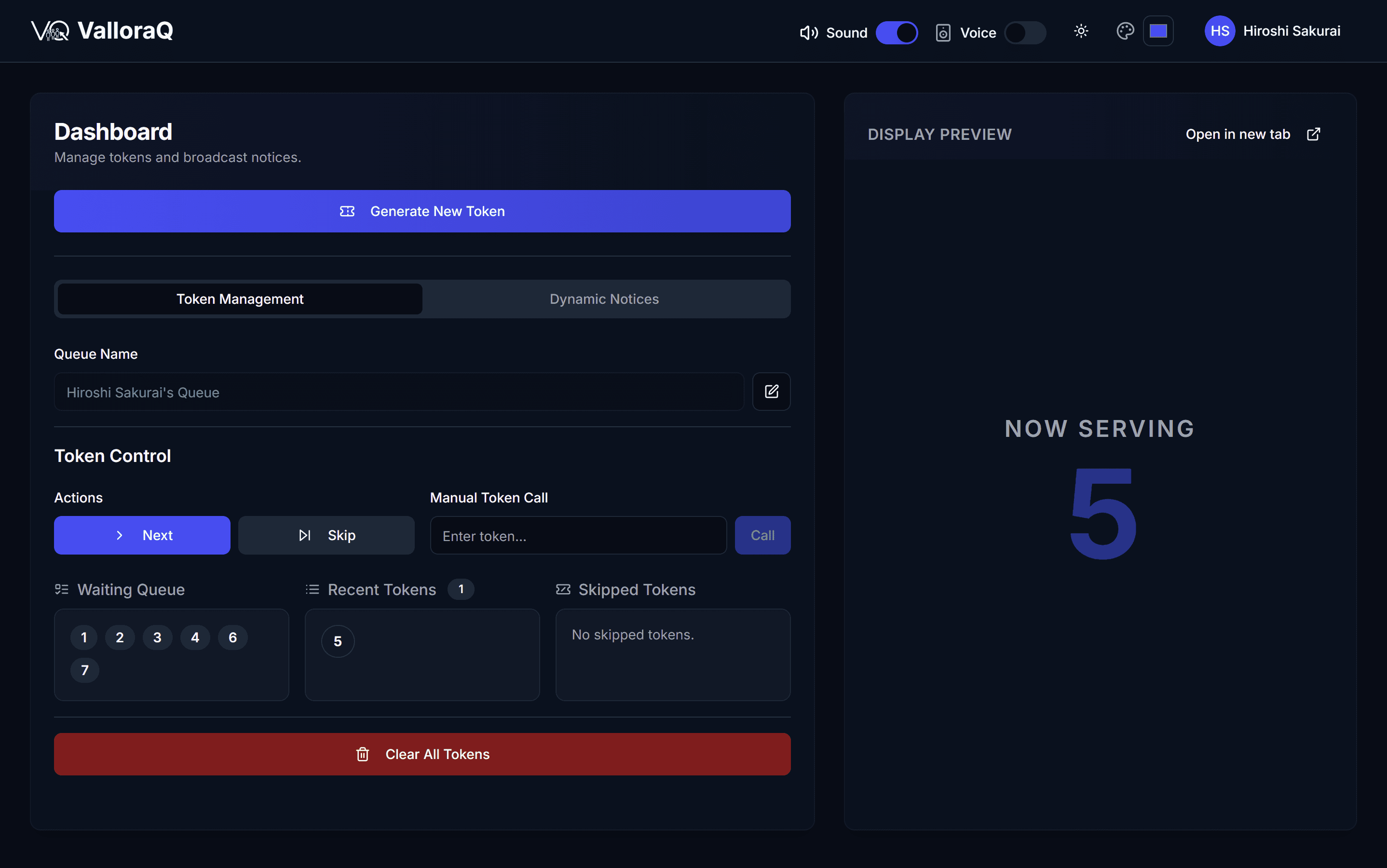
ValloraQ (our product) starts from a simple premise: a clinic or service center shouldn't buy kiosks to run a queue. Tokens are issued from any browser, the waiting-area display runs as a Windows app on any PC or TV, and customers are called by AI voice announcements in a clear, natural voice — no receptionist shouting, no beeping box.
- Strengths: zero proprietary hardware; multi-counter and multi-department routing; live wait analytics; per-location subscription pricing that fits SMB budgets; built with Indian clinics, labs, and service centers as the core market. Pairs natively with OPD Connect for clinics that want queue + records + billing in one flow.
- Trade-offs: we don't chase airport- and stadium-scale tenders — branch networks in the hundreds with custom kiosk fleets are enterprise-vendor territory.
- Fit: single- and multi-site clinics, diagnostic labs, government service counters, telecom/service centers, and any business where people wait for counter service. (Clinic specifics: queue management for clinics.)
Qmatic — the enterprise standard
Qmatic has run queues in banks, hospitals, and government offices worldwide for decades. For a 200-branch network needing kiosks, appointment integration, and centralized analytics, it's a safe, proven choice — with the procurement process and pricing to match. Single sites and small chains will find the platform (and the quote) sized for someone else.
Wavetec — kiosks plus signage
Wavetec is strong where queuing meets digital signage — banks and telcos that want self-service ticket kiosks, large-format displays, and customer-feedback units as one hardware estate. If that describes you, they're credible; if you're a clinic with one waiting room, you'd be buying a lot of hardware to get a token number on a screen.
Qminder & Skiplino — clean SaaS, different bets
Qminder does simple, elegant walk-in queuing on iPads for service desks and has a loyal following in retail-style environments. Skiplino bets on virtual queues through the customer's phone app — powerful when your customers will install an app, limiting when they won't (which, for walk-in clinics in India, is most of the time). Both are solid products with USD pricing and no India-specific support motion.
How to choose quickly
- Single site or small chain in India → software-first wins on cost and speed; you can be live this week. That's ValloraQ's home ground.
- Large branch network with kiosk requirements → shortlist Qmatic and Wavetec and budget accordingly.
- Whatever you pick: demo with your real peak hour in mind, confirm the announcement quality in a noisy room, and get total first-year cost — hardware included — in writing.
Queues are one of the few operational problems where the fix is visible to every customer within a day of installation. If you want to see it on your own waiting room's TV, book a ValloraQ demo — and if you're weighing budgets first, our queue system cost guide breaks down what you should expect to pay.
Frequently asked questions
- Which is the best queue management system in India?
- For small and mid-size Indian businesses — clinics, diagnostic labs, service centers — ValloraQ offers the strongest value: digital tokens, AI voice announcements, and displays on hardware you already own. Enterprise deployments with branch networks and custom kiosks are where global vendors like Qmatic and Wavetec fit.
- How much does a queue management system cost in India?
- Software-based systems that reuse your existing PCs and TVs are priced as an affordable per-location subscription. Traditional kiosk-and-hardware systems from enterprise vendors typically run into lakhs per site once kiosks, printers, displays, and installation are counted.
- What hardware is needed for a token queue system?
- Modern software-first systems need only what most businesses already have: a PC, tablet, or phone at reception to issue tokens, and a TV or monitor in the waiting area for the queue display. Kiosks and thermal token printers are optional extras, not requirements.
- Do queue management systems work for small clinics?
- Yes — clinics are one of the best-fit use cases. A visible token queue with voice announcements calms the waiting room, frees reception from constant 'how many more?' questions, and typically improves patient satisfaction before average wait times even change.
Ready to launch fast and scale smart?
Kaelix Technologies builds rapid, AI-powered software for growing businesses. Tell us your workflow and we'll show you what's possible.